


Removal of Potassium, Sodium, Aluminum, and Titanium Impurities from Quartz Sand via Flotation: Technical Rationale and Process Configuration for a Complete Reagent Solution
I. Key Conclusions
Flotation of quartz sand to remove potassium, sodium, aluminum, and titanium impurities is an indispensable technical step in the purification of quartz sand. Potassium and sodium are often associated with feldspar and mica, while aluminum and titanium are present both as gangue mineral phases and, in part, incorporated into the quartz crystal lattice.Flotation can effectively treat gangue minerals after single-mineral liberation, as well as impurities exposed on the surface; however, aluminum and titanium within the crystal lattice require a combination of processes. The key to the flotation separation of feldspar from quartz lies in controlling the pulp pH window and optimizing the collector system.Flotation of quartz sand to remove potassium, sodium, aluminum, and titanium impurities requires a comprehensive chemical treatment plan covering pH adjusters, collectors, inhibitors, and auxiliary adjusters, which must be determined through pilot testing; there is no universal formula.
II. The Form of Occurrence Determines the Process Route
Potassium and sodium are primarily found in feldspar and mica. When feldspar, mica, and quartz are sufficiently liberated as individual particles, flotation can effectively separate them; however, when feldspar particles are fine or tightly intergrown, flotation selectivity decreases significantly.
Aluminum falls into two categories: one is found in feldspar and mica and belongs to the gangue mineral type; the other replaces silicon in the quartz crystal lattice, becoming lattice aluminum, which cannot be liberated no matter how finely the ore is ground and is difficult to remove by flotation.Titanium is even more challenging: while free-standing titanium-bearing minerals can be reliably treated by magnetic separation and flotation, conventional flotation is largely ineffective against lattice-bound titanium.
Therefore, before determining the process flow, it is essential to clearly analyze how much of the potassium, sodium, aluminum, and titanium originates from gangue minerals and how much is present in the crystal lattice. The former is the primary focus of flotation, while the latter requires enhanced methods such as acid leaching and chlorination roasting.The starting point for developing a reagent scheme to reduce potassium, sodium, aluminum, and titanium impurities in quartz sand flotation is an accurate assessment of their occurrence states.
III. Which Ores Are Suitable for Flotation?
Suitability is primarily determined by three factors: the content and grain size of feldspar and mica; whether the impurities are gangue-type or lattice-type; and the target product grade.
For ores where gangue minerals consist primarily of potassium, sodium, and aluminum, and where individual mineral liberation is good, flotation is the method of choice. For ores where aluminum and titanium are primarily locked within the crystal lattice, flotation can only partially address the issue and must be combined with acid leaching or roasting.For the production of ordinary glass sand, flotation may be a one-step process; for photovoltaic or electronic-grade sand, flotation is typically used as a roughing or concentrating stage, followed by acid leaching.
For ores with extremely low feldspar content but relatively high levels of lattice-type aluminum and titanium, flotation is of little value; for ores with severe muddiness and high fine silt content, flotation selectivity deteriorates, requiring desliming first.For a preliminary assessment, consider the grades of K₂O, Na₂O, Al₂O₃, TiO₂, and SiO₂ together: If potassium and sodium are high while aluminum is low, the impurities are likely feldspar-type;if aluminum is significantly high while potassium and sodium are not, be wary of lattice aluminum; when titanium is high, first determine whether it is independent titanium minerals or lattice titanium. A more accurate assessment still relies on mineralogical analysis.
IV. Principles of Flotation Separation of Feldspar and Quartz
Feldspar and quartz have similar crystal structures; after crushing, both carry a negative surface charge, have low zero-charge points, and exhibit similar natural floatability. The difference lies in the fact that the zero-charge point for feldspar is roughly between pH 1.5 and 1.9, while that for quartz is around pH 2 to 3.By controlling the slurry pH between 2 and 3, the quartz surface becomes nearly electrically neutral, while the feldspar surface remains negatively charged. Cationic collectors preferentially adsorb onto feldspar, causing it to float to the surface with the foam.
Relying on a single amine-based collector yields limited results, as amines primarily rely on electrostatic adsorption for both feldspar and quartz, resulting in insufficient selectivity.What truly enhances separation efficiency is a mixed anionic-cationic collector system: the anionic collector undergoes specific adsorption with the active Al³⁺ sites on the feldspar surface, while the cationic collector acts through a synergistic combination of electrostatic and molecular adsorption. Each occupies a site, collectively raising the hydrophobicity of the feldspar surface.The quartz surface lacks active Al³⁺ sites and exhibits much weaker adsorption of the collectors. When flotation is used to remove potassium, sodium, aluminum, and titanium impurities from quartz sand, the collector ratio must be adjusted based on the type of feldspar and the activity of aluminum; generic formulations cannot be applied indiscriminately.
V. Four Categories of Components in a Complete Reagent Scheme
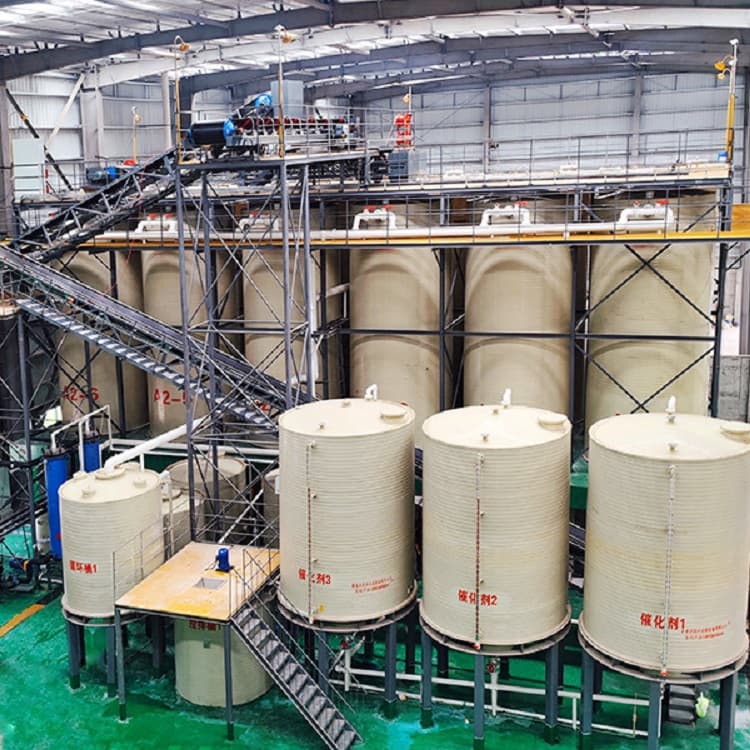
For the flotation of quartz sand to remove potassium, sodium, aluminum, and titanium impurities, a complete chemical treatment plan must include at least four types of chemicals.
pH adjusters: Typically sulfuric acid or hydrochloric acid is used, with the pH window controlled between 2 and 3. If the pH is too high, both feldspar and quartz become negatively charged, resulting in a loss of selectivity; if the pH is too low, the quartz surface becomes positively charged, causing the collector to adsorb onto the quartz as well.
Collectors: The core of the process, utilizing a combination of cationic and anionic components. The cationic component forms an electrostatic adsorption framework on the feldspar surface, while the anionic component binds to Al³⁺ active sites to form a synergistic hydrophobic layer. The ratio is determined through flotation tests.
Inhibitors: Sodium silicate and sodium hexametaphosphate are commonly used quartz inhibitors; they enhance the hydrophilicity of the quartz surface, causing it to remain at the bottom of the cell. Sodium hexametaphosphate also acts as a dispersant, reducing the impact of fine silt coverage.
Auxiliary Adjusting Agents: Selected based on the characteristics of the ore. A small amount of activator may be required when the Al³⁺ activity on the feldspar surface is insufficient; organic inhibitors may be used in combination to suppress mica.
Although these four types of reagents serve different functions, they share a common goal: to draw feldspar and mica into the froth while retaining quartz at the bottom of the cell. The value of the process lies not in the name of any single reagent, but in the ratio of these four components and the sequence of their addition.
VI. Comparison of Flotation with Other Impurity Removal Processes
| Process Methods | Applicable Materials | Advantages | Limitations |
|---|---|---|---|
| Flotation | Garnet, feldspar, and mica as gangue minerals | Good selectivity for individually liberated gangue minerals; suitable for continuous production | Ineffective against lattice impurities; significantly affected by fine silt |
| Strong Magnetic Separation | Independent iron-titanium-bearing minerals | Effective for ilmenite, hematite, and similar minerals; simple process | Ineffective for feldspar and mica; ineffective for lattice titanium |
| Gravity separation | Minerals with significant density differences | Low cost; no chemical consumption | Feldspar and quartz have similar densities, resulting in low separation efficiency |
| Acid leaching | Lattice impurities, surface inclusions | Some removal of lattice aluminum and titanium | High chemical consumption and high waste liquid treatment costs |
| Chlorination roasting | Lattice impurities | Significantly effective at removing lattice aluminum and titanium | High energy consumption, significant capital investment in equipment, and the need to treat exhaust gases |
In actual processes, flotation is typically the primary method for reducing potassium, sodium, and aluminum, while magnetic separation is used to remove iron and titanium as independent minerals, and acid leaching or roasting serves as a supplementary process for deep purification.Quartz sand flotation is used to remove potassium, sodium, aluminum, and titanium impurities; the reagent formulation addresses selectivity in the flotation stage, and the subsequent process sequence must be determined based on the characteristics of the ore.
VII. Key Parameters Affecting Flotation Performance
| Parameter | Typical Range | Explanation of Impact |
|---|---|---|
| Grinding Fineness | Determined based on grade distribution tests | If too coarse, liberation is insufficient; if too fine, severe sludging occurs |
| Slurry Concentration | 20% to 35% | Higher concentrations result in higher throughput but poorer selectivity; lower concentrations have the opposite effect |
| Pulp pH | 2.0 to 3.0 | Critical range for feldspar flotation; excessive deviation leads to separation failure |
| Flotation Temperature | Room temperature to 40°C | Affects the dissolution and adsorption of amine collectors |
| Agitation Intensity | Moderate speed; avoid strong shear | Excessive agitation can cause the collector film to desorb |
| Number of selections | 2 to 3 times | Rough selection to remove feldspar; fine selection to reduce quartz carryover |
These parameters must be adjusted based on the ore\'s particle size, mineral distribution characteristics, and target grade, and ultimately verified item by item through pilot testing.
VIII. Process Configuration for Different Target Grades
| Target Application | Major Impurity Limits | Recommended Process Configuration |
|---|---|---|
| Ordinary Glass Sand | Relatively lenient requirements for potassium, sodium, aluminum, and titanium | Primarily flotation, supplemented by magnetic separation as needed |
| Ultra-clear glass sand | Stricter requirements for iron and titanium; certain restrictions on potassium and sodium | Flotation combined with magnetic separation, followed by acid leaching if necessary |
| Photovoltaic glass sand | Strict requirements for potassium, sodium, aluminum, and titanium | Flotation combined with magnetic separation, supplemented by acid leaching or a flotation-based alternative to acid leaching |
| Electronics-grade quartz sand | Strict impurity requirements | Multi-stage combination of flotation, magnetic separation, acid leaching, and roasting |
The role of flotation varies depending on the target grade.For ordinary glass sand, a single-step process may suffice; for photovoltaic or electronic-grade sand, flotation typically serves as a roughing or concentrating stage, followed by acid leaching or roasting for further impurity removal. Flotation of quartz sand reduces potassium, sodium, aluminum, and titanium impurities; the reagent scheme must be matched to the target grade, and the positioning of the flotation stages is determined accordingly.
IX. Process Integration When Crystal Lattice Aluminum and Titanium Levels Are Elevated
When the proportion of lattice aluminum and titanium is high, relying solely on flotation to reduce potassium and sodium levels will leave the aluminum and titanium trapped, making it difficult to improve product purity. A study conducted on a specific quartz sandstone developed a complete processing route:Following crushing, grinding, desliming, and strong magnetic separation, neutral reverse flotation and alkaline direct flotation are performed, followed by acid leaching with a mixed acid solution of hydrofluoric acid and phosphoric acid. This is then followed by calcination and a second acid leaching, ultimately achieving a SiO₂ grade of over 99.9%.with a high removal rate for aluminum, followed by iron, and the lowest for titanium. This indicates that even after acid leaching and calcination, the removal of lattice titanium remains a challenge.In another case, a feldspar mine employed a fluoride-free flotation process for separation, resulting in a significant increase in the SiO₂ content of the quartz concentrate; however, it still fell short of the standards for high-purity sand.
It should be noted that the hydrofluoric acid step in the aforementioned research approach is used for the deep leaching of lattice impurities and constitutes a process combination at the research level;The complete reagent scheme for reducing potassium, sodium, aluminum, and titanium impurities in quartz sand via flotation follows a fluoride-free, acid-based route; whether acid leaching is required and which acid system to use is determined by the ore conditions and test results.
A reasonable approach is as follows: flotation is responsible for removing gangue mineral-type impurities, while acid leaching or roasting is responsible for treating lattice and inclusion impurities. Each of these two process stages has its own specific role; it is not advisable to place all expectations on the single flotation stage.
X. Case Study: Transition from a Single Collector to a Combined System
At a certain quartz sand mine, the original ore had a relatively low SiO₂ grade, with feldspar and a small amount of mica as the main impurities; potassium, sodium, and aluminum were relatively high, while titanium was relatively low.Initially, a single dodecylamine was used as the collector, with the pH adjusted to 2.5. After flotation, potassium and sodium levels decreased somewhat, but the reduction in aluminum was limited, and the grade improvement was unsatisfactory.
Microscopic and XRD analyses revealed slight sericite transformation on the surfaces of feldspar particles, partially covering the active Al³⁺ zones and resulting in poor amine adsorption; simultaneously, the fine silt content was high, causing fine-grained quartz to be carried into the concentrate with the froth.
Adjustment plan: Switch the collector to a combined cationic-anionic system, appropriately increase the proportion of the anionic component, and use a mixed amine as the cationic component; add sodium hexametaphosphate as a dispersant; and add a desliming step before roughing.
Following these adjustments, K₂O + Na₂O levels decreased to relatively low levels, Al₂O₃ showed a significant reduction, TiO₂ remained essentially unchanged, and the SiO₂ grade increased to over 99%, meeting some of the requirements for sand used in photovoltaic glass. However, acid leaching is still required if higher purity is needed.Specific indicators may vary depending on the conditions of the raw ore and the scale of the trial.
This adjustment demonstrates that the reagent scheme must be tailored to the properties of the ore. The shift from a single collector to a combined system, and from omitting desliming to incorporating it, provides significant reference value for similar mines.Reagent optimization for reducing potassium, sodium, aluminum, and titanium impurities in quartz sand flotation often involves adjusting a set of reagents rather than simply replacing a single reagent.
XI. Common Technical Questions
Q: Does the chemical scheme include hydrofluoric acid? No. While the hydrofluoric acid method is highly effective for separating feldspar from quartz, it poses significant environmental and occupational health risks and is generally not recommended for new projects. The complete chemical scheme follows a fluoride-free, acid-based approach, relying on pH window control and a combination of collectors to establish selectivity.
Q: To what level can potassium and sodium be reduced after flotation? This is constrained by the feldspar content and the size of the embedded particles in the ore.For ores with low feldspar content and good liberation, potassium and sodium levels can be reduced to relatively low levels; for ores with high feldspar content and fine-grained feldspar, the reduction achieved by flotation is limited, and the remaining portion must be addressed through acid leaching. The specific extent must be determined through pilot testing; it is not advisable to commit to absolute values without considering the specific ore conditions.
Q: What percentage of the cost is typically attributed to reagents? This is directly related to the feldspar content; higher feldspar content requires greater amounts of collector. The consumption of pH adjusters depends on the slurry\'s buffering capacity. When assessing economic viability, consider the proportion of reagent costs relative to the value added to the concentrate; if this proportion is too high, the plan should be reevaluated. Since there are significant variations among different ore sources, no uniform ratio can be provided.
Q: What preparations are needed before flotation? First, conduct a mineralogical analysis to determine the occurrence states of potassium, sodium, aluminum, and titanium; then carry out flotation test runs to determine the pH, collector ratio, and inhibitor dosage; once the conditions are established, design the process flow and chemical regimen.
Q: How are flotation tailings treated? Tailings are enriched with feldspar and mica. If the feldspar grade reaches a certain level, it may be recovered as feldspar concentrate for use in the ceramics or glass industries; if no recoverable components are present, the tailings are treated as general industrial tailings. Tailings water is recycled or discharged in compliance with regulatory standards after sedimentation and pH adjustment, with specific procedures determined in accordance with local environmental protection requirements.
Q: Can you provide on-site commissioning? A: Yes. Once the chemical treatment plan is finalized, technical personnel will visit the site to assist with commissioning, fine-tuning dosages and process parameters. The focus is on implementing the flotation chemical regimen, including calibrating dosing points, dosing sequences, and specific consumption on a section-by-section basis.
XII. Service Process: From Ore Analysis to Implementation of the Reagent Plan
For the flotation of quartz sand to remove potassium, sodium, aluminum, and titanium impurities, we develop a chemical treatment plan—we do not merely sell chemicals.After receiving ore samples, we first conduct a mineralogical analysis to determine the occurrence states of potassium, sodium, aluminum, and titanium; then we perform flotation condition tests to verify pH, collector ratios, and inhibitor dosages one by one. Once the conditions are determined, we provide a complete chemical regimen, including the types, dosages, and dosing points for each stage of the process.
A comprehensive chemical treatment plan means you receive not just isolated products, but a flotation chemistry solution tailored to the specific characteristics of your ore. During the on-site commissioning phase, civil engineering and general installation personnel are organized locally by the project owner, while our engineers are stationed on-site to guide the implementation of the flotation chemical regimen, ensuring both the quality of commissioning and control over labor costs.
If potassium, sodium, aluminum, and titanium levels in an existing quartz sand mine cannot be reduced, or if flotation recovery rates are unsatisfactory, please send us the chemical analysis data and mineral composition of the raw ore. We will first determine whether the impurities are primarily gangue-type or lattice-type, and then advise whether the issue can be resolved through flotation alone or requires a combined process.There is no charge for this preliminary assessment; formal mineral processing tests are billed as agreed, and the fees may be offset against the cost of any subsequent equipment or engineering contracts.
The core of a comprehensive reagent solution for reducing potassium, sodium, aluminum, and titanium impurities in quartz sand flotation lies in aligning the ore properties, reagent ratios, and process parameters.From assessing the ore\'s occurrence to designing the flotation circuit, and from establishing the reagent regimen to on-site commissioning, we form a complete technical chain to help quartz sand projects reduce potassium, sodium, aluminum, and titanium to target levels.